
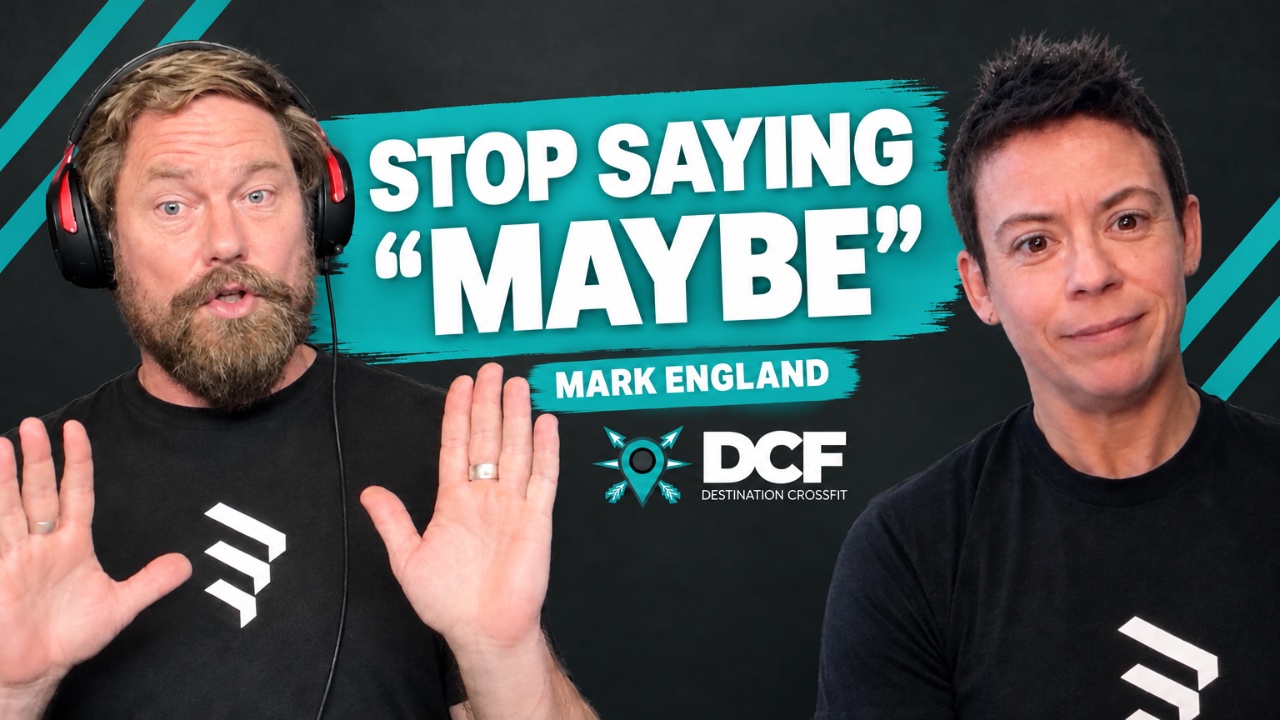
It took three tries to get this episode recorded.
Mark England rescheduled once. Then I rescheduled (small children, some crying). Third time’s the charm.
Mark is a friend, a mentor, and the co-founder of Enlifted. He’s been coaching mindset full time for almost 20 years, and he used our delay to make a point I’ve been chewing on ever since: most of us don’t talk ourselves out of things with big, dramatic reasons. We do it quietly, with small words.
What is mindset, really?
Mark read me a stack of mindset definitions (he had about 30 on his list). A mental attitude. A set of beliefs. A cognitive framework installed in our minds. (I may have called it gobbledygook.)
His version fits on a sticky note: your mindset is the story you tell yourself. Your story about money. About your partner. About your body and your fitness.
And every one of those stories is made of two things: words and breath. Improve the quality of your breath and the words get better. Improve the words and the breath gets better. Mark calls it a feedback loop.
Why do we talk ourselves out of doing things?
Mark’s take: perfectionism is a sneaky form of imposter syndrome. “I’ll schedule it when I’m 100% ready” is a polite way of never scheduling it.
His fix runs backwards from how most of us work. Lock in the when, the where, how long, and who you’re inviting first. Book the workshop. Build the curriculum after.
He also walked through a writing exercise. Write “Maybe I’ll actually give a workshop in October.” Now cross out “actually” (it implies surprise, as in who do I think I am?). Cross out “maybe.” Suddenly you’re not wondering, you’re messaging someone about a room. That’s the idea behind Kidlin’s Law: a question that’s well worded and written down is already half answered.
His simple formula: underthink it and win.
What does slowing your speech by 5% actually do?
This is the part that hit home for me, because I see it in my clinic all the time.
Parents often walk in up-regulated, with a tight chest. In session, we practice slowing down how we speak to the kid. The kid practices it. We notice what shifts in the room. It’s measurable, the parent can feel it, and that means they can repeat it at home.
Mark’s explanation: slowing down 5% means you’re choosing your words consciously instead of running on habit, and it loosens your breath by more than 5%. He was upfront that this is his personal experience, not a clinical study. His words: it just does, and he can feel it.
The bigger payoff, in his words: “fewer words, better words, better breathing.” Mark says he uses roughly 30 to 35 percent fewer words than he did at 25, and has more energy for it. His view is that children mirror their parents’ breathing, so a calmer pace is a free gift to the people you live with.
What is soft talk, and how do I stop it?
Soft talk is the small hedge words that keep a decision from landing: probably, perhaps, feels like, guess, maybe, could, might, possibly, sort of, kind of, potentially, hopefully, try, one day, should, almost like.
Mark had me say this out loud: “I think I might be overthinking things.”
How did it feel? Confused. A little icky in my stomach. My eyebrows scrunched.
Then we crossed out “I think.” Then “might.” Now it reads: “I am overthinking things.”
Same sentence. Clearer. More decisive. Totally different feeling in my body.
Mark’s point is that soft talk is a slick way of kicking the can down the road. “Maybe I should go for that promotion” never puts your name in the hat. This isn’t about being harder on yourself. It’s about being clearer with yourself.
How can I try this at home? The 3-step protocol
- Slow down 5% in one conversation today. Then notice the quality of the energy: light or heavy, expansive or dense?
- Write the soft talk list. Clean sheet of paper, all caps, five times bigger than your normal handwriting. Stick it on the fridge for 30 days.
- Catch one, cross it out, say it again. Notice what changes.
Bonus round for the brave: pick up a pen and write out one old, scary story that’s been living in your head. Mark says it’s a different kind of heavy than your deadlift PR, and “pepper burns twice”: it stings going out, too. If it feels like a lot, bring a coach or counselor along for the ride.
Frequently asked questions
What is the Enlifted definition of mindset? Your mindset is the story you tell yourself, and that story is made of words and breath.
Does slowing down your speech by 5% really change anything? Mark’s experience is that it connects your words and your breath, and he sees it in the people he coaches. It’s a free, low-risk thing to test for yourself this week.
What are soft talk words? Hedge words like maybe, might, probably, sort of, kind of, hopefully, try, and should. Removing them from a sentence often makes it clearer and more decisive.
Join us
Snap a photo of your fridge sheet and tag @dcfwallawalla and @enlifted.coaches. We’ll repost you.
We’re also building a 4-week mindset workshop for November and a parents program built on these same tools.
November 15.
Curious how mindset fits into your fitness? Book a free consultation at wwdcf.com/free-consultation/ and let’s talk.


